
Beyond Screen Time: Strategies for Managing Problematic Gaming and Tech Use in Teens
By Joe Tarantino, Ph.D. (CA 33972, NY 023917)
I hear this regularly from families working with me: modern parenting means a constant tug-of-war with tech, usually a gaming console, tablet, or smartphone. You are not alone in thinking that your teen might be addicted to their device, but chances are, it's not your kid—it's the design.
Games and apps are built to optimize for engagement. Understanding how they work helps you become an ally, not an adversary.
At Practice SF, we want to help parents shift the conversation around tech use. Understanding the psychology of tech design and the framework of healthy balance can help parents move from feeling like an adversary to an ally.
What is Problematic Tech Use?
One of the biggest misconceptions about technology use is that "problematic use" or addiction are defined by the number of hours spent on a screen or a console. In reality, problematic use and addiction are not about total screen time hours, but about whether tech is causing what clinicians refer to as “functional impairment.”
The key question isn't "How long have they been playing?" but rather: Is tech use crowding out life’s essentials?
Specifically, tech use should not significantly interfere with any of the following:
Physical health: Are they eating, sleeping, and maintaining hygiene regularly?
Activity: Is there still regular physical movement in their day?
Academics: Are grades and school responsibilities being met?
Social Life: Is there quality time spent with family and friends?
If tech is "crowding out" any of these activities, intervention may be warranted. While studies indicate true "Gaming Disorder" as defined by the WHO is rare (affecting only about 1–2% of players), the struggle is very common: many teens have difficulty with tech usage and gaming habits that negatively impact their well-being on a daily basis.
It’s Not the Kid—It’s the Design
It is vital for parents to realize that games and apps are designed to hook. The American Academy of Pediatrics (AAP) notes that games are designed to make players want to keep playing, and randomly reward players frequently enough to maintain engagement, making it incredibly difficult for the developing adolescent brain to disengage.
The "Dopamine Loop" and What to Watch For
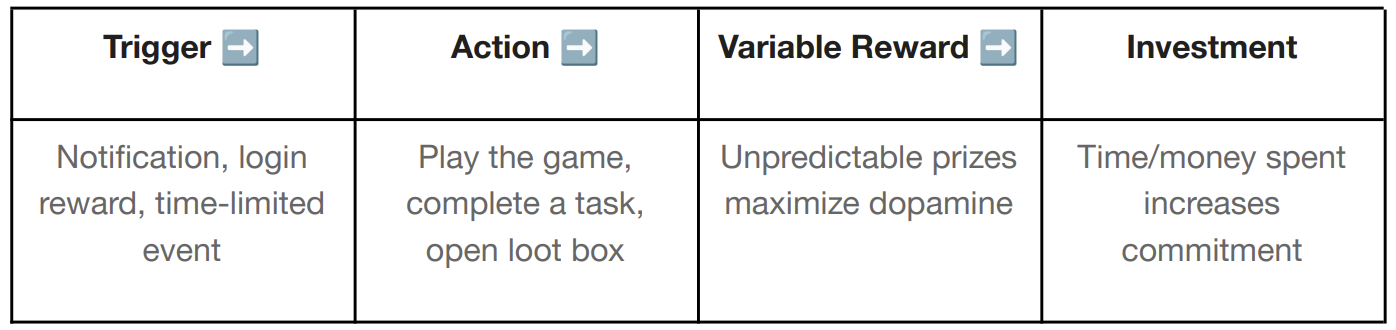
The cycle repeats, creating a powerful pull that's hard to resist — by design.
Gambling Mechanics in Games - why it matters:
Loot Boxes : These are features in video games that can be accessed through gameplay and are often purchased with real-world money. Some surveys have shown that more than 90% of kids play games regularly, and up to 40% are making in-game purchases. One study indicated that these features have significant links to gambling behaviors.
The Battle Pass: This is a subscription-type feature that unlocks rewards as you play using limited timeframes and daily challenges that create a sense of pressure to play (FOMO) and sunk-cost fallacies (“I paid for it, so I need to finish it"), as well as other time manipulation tactics like punishing players for taking a day off.
Understanding these tactics gives you the ability to move from blaming your teen for not having enough willpower to talking with them about how these systems are engineered to hook them and create a sense of obligation. This can help shift the kid or teen's perspective from "mom/dad is being mean" to "this game is trying to manipulate my time."
Balance, Boundaries, and Communication
To foster a healthier relationship with tech, we recommend the AAP framework: Balance, Boundaries, and Communication.
Balance: Unique to each family
Help your teen figure out the right balance between online and offline time, with the goal being to ensure that screen time never significantly undermines the essentials:
Eating
Sleeping
Socializing
Academics
Physical Activity
Boundaries: Collaborate, don’t dictate
Set limits on what, where, and when tech is used, be sure to discuss what personal info should never be shared. Try these:
Involve them: collaborate with your teen on when their gaming time happens (e.g., offering them to choose if they’d like to play after homework or on weekends).
Create Tech-Free Zones: Make mealtimes device-free, and keep charging stations in common areas.
Use the Tools: Lean on parental controls: Apple Screen Time, Google Family Link, console-specific apps (Xbox, PlayStation, etc.,) to automate the boundaries you’ve agreed on.
Communication: Talk about it, regularly
Create a space where your child feels comfortable coming to you. You don’t need to be a gaming expert to be a supportive parent. Get curious: ask them what they like about the game, and occasionally sit down and play with them.
Lead by Example
Do you keep your phone at the dinner table? Are you the first one to look at a screen in the morning? Being honest and transparent about your own tech use struggles with "doom-scrolling" or email can show your teen that managing tech is a skill everyone has to practice. Teens are more receptive to rules that parents follow too.
Connect with other Parents
It’s easier to enforce limits when friends have similar rules. Start a conversation with other families, bring it up at parents’ night, build support for tough conversations.
When to Seek Professional Help
Problematic gaming often co-occurs with challenges like ADHD, anxiety, or depression, and studies indicate that in some cases, mental health difficulties may be an underlying cause of problematic tech use. If you see aggressive outbursts when gaming is restricted, a significant decline in grades, or marked social withdrawal, we strongly recommend consulting with a professional.
Don’t hesitate to reach out to Practice San Francisco if you feel like you or your teen might need support. We offer comprehensive psychological evaluations as well as individual therapy for children, tweens, teens, and parents.
Recommended Zero-Cost Resources for Parents:
AAP Family Media Plan & Center of Excellence: aap.org healthychildren.org/MediaUsePlan
Parental Control Guides: esrb.org/tools-for-parents
Game Reviews: commonsensemedia.org
Be Internet Awesome; beinternetawesome.withgoogle.com
We also invite you to have a look at Practice SF’s resources for parents at https://www.practicesanfrancisco.com/resources