
A Therapist’s Book Review for Parents: The Emotional Lives of Teenagers by Lisa Damour, PhD
by Molly McCobb, LCSW (#98584)
As a therapist working with adolescents, I often see parents arrive in my office exhausted and fearful, feeling as though their teenager’s intense emotions are a sign that something is "broken." Dr. Lisa Damour’s work serves as a powerful corrective to this fear. Her core message is a relief to hear:
Mental health isn't about feeling good; it’s about having the right feelings at the right time and managing them effectively.
The Neurology of the "Hot" Brain
One of the most valuable takeaways for parents is the distinction between "Cold" and "Hot" Cognition. During adolescence, the limbic system (the brain's emotion center) undergoes a massive renovation while the prefrontal cortex (the "logic" center) is still under construction.
When your teen is alone or in a calm environment ("Cold"), they can be incredibly rational. However, once they are with peers or in a high-stakes social moment ("Hot"), the amygdala takes the wheel, often "bulldozing" their logic.
As a therapist, I encourage parents to use Damour's advice: Strategize during the "Cold" times.
Don't wait for the high-stakes social moment like a party with peers or other weekend event, instead, ask them on a quiet Tuesday afternoon or during downtime at home; "How do you want to handle things if a situation gets dicey this weekend?"
Gender, Race, and Emotional Expression
Damour highlights how socialization often narrows the emotional vocabulary of our children. Boys are often conditioned to trade sadness for anger, leading to externalizing disorders (acting out), while girls may turn anger into anxiety, leading to internalizing disorders.
Particularly poignant is the discussion on adultification (a form of race prejudice). For parents of Black teens, it is vital to recognize that society often views Black girls as more sexual and Black boys as more dangerous than their white peers. This "racist amplification" means these teens often face harsher consequences for normal adolescent behavior. Our job as a support system is to provide a home environment where they can shed these heavy stereotypes and be seen for the developing children they actually are.
A Toolkit for Home
From a CBT perspective, Damour offers three "golden" strategies for parents to use at home:
Emotional Granularity: Help your teen move past "I'm fine" or "I'm mad." Being able to distinguish between "disappointed," "lonely," or "embarrassed" actually changes the brain’s chemistry, reducing the voltage of the emotion.
The "Validation First" Rule: Before you offer a solution, offer empathy. Research shows that empathetic parenting actually lowers systemic inflammation in a teen's body. Your presence is often more therapeutic than your advice.
The Circle of Control: When a teen is spiraling, help them sort the problem into "what I can change" and "what I cannot change."
When to be Concerned
While mood swings and "externalizing" (unloading stress on you) are normal, we must look for rigid defenses. If a teen is using substances, self-harm, or constant suppression to control their feelings, it’s time to seek professional help.
Final Thought
If you take one thing from Dr. Damour, let it be this: You do not need to be afraid of your teenager’s pain. When you stay calm while they are undone, you communicate that their discomfort is survivable. You are the steady anchor in their storm.
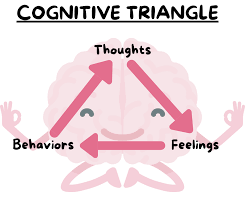
To help you translate Dr. Damour’s strategies into action, I’ve put together a few scripts. These are designed to help you navigate those high-intensity moments while keeping the CBT Cognitive Triangle (Thoughts, Feelings, and Behaviors) in mind.
Scenario 1: The "Cold" Strategy (Before a "Hot" Event)
Use this when your teen is calm, perhaps in the car or while doing a low-stress activity.
Parent: "I know you’re heading to that bonfire tonight. When it’s just us, together, it’s easy to say 'I’ll be safe,' but I know when everyone is hyped up, it’s a different vibe. Have you thought about what you’ll do if things get a bit 'high-voltage' or dicey? I’m not asking because I don't trust you, I’m asking because I want to be your backup plan if the hot logic kicks in."
Scenario 2: When the Teen is "Externalizing" (Unloading on You)
Use this when they come home and start snapping at you or blaming you for a bad day.
Parent: (Taking a deep breath to stay calm) "It sounds like you had a really heavy day and you’re carrying a lot of heat right now. I can hear how frustrated you are. I’m going to stay right here and listen. You don't have to fix it right this second, and I’m not going to jump in with advice. I’m just here to be a steady place for you to offload that stress."
Scenario 3: Increasing "Emotional Granularity"
Use this when they are stuck in a vague "bad" mood.
Parent: "You mentioned you’re feeling 'gross' about school. I want to make sure I really get it. Does 'gross' feel more like you’re overwhelmed by the workload, frustrated with a specific teacher, or maybe a bit lonely during lunch? Pinpointing the exact flavor of the feeling usually helps dial down the intensity."
Scenario 4: Handling "Purposeless" School Tasks
Use this for the kid frustrated with the mandatory school event.
Parent: "I hear you that the school event tomorrow feels like a total waste of time. It’s hard to show up for things that don't feel 'purposeful.' Since we can't change that you have to go, let’s look at the Circle of Control. You can’t control the event, but can we find a 'micro-purpose'? Maybe the purpose is just to catch up with that one friend you like, or to practice 'detachment' while you're there?"
Scenario 5: When You Make a Mistake (The 6-Step Apology)
Use this if you overreacted or "fixed" instead of listened.
Parent: "I’m sorry I jumped in with solutions earlier when you just needed to vent. I realize I was making it about my anxiety instead of your experience. I took over the conversation, and that wasn't fair. Next time, I’ll ask if you want 'help or just a hearing' first. I hope you can forgive me so we can keep talking."
For more information about Practice San Francisco, our programs and groups for kids and teens, individual therapy for kids, tweens, teens, and parents, or our comprehensive psychological evaluations, contact us today!