
What is a Psychological Evaluation? (And How It Helps Your Child Thrive)
Think of a psychological evaluation—sometimes called testing or assessment—as a comprehensive roadmap to your child’s unique brain. By using a mix of specialized tools and clinical insight, we look beneath the surface to understand how they learn, how they feel, and why they behave the way they do. At Practice San Francisco, this process is led by an expert to understand the "why" behind a child’s emotions, behaviors, and academic life.
Building a Baseline for Growth, Providing Tools of Empowerment
One of the most powerful parts of testing is that it gives us a clear starting point. This baseline is incredibly helpful for:
Tracking Progress: Seeing exactly how your child grows over time.
Adapting the Plan: Making sure their therapy or school support stays as dynamic as they are.
Identifying Strengths: We don’t just look for "problems"—we pinpoint your child’s natural talents. Knowing where they shine is the best way to build the resilience and self-esteem they need to handle life's "sticky" moments.
Whether your child is facing a specific hurdle at school or struggling with big emotions at home, an evaluation is a way to stop guessing and start supporting. The insights we gain aren't just scores on a page; they are the internal scaffolding that helps your child navigate their journey with more confidence and ease.
Our Collaborative Assessment Framework
We believe that behavior is a two-sided coin: on one side is the challenge, and on the other is the potential for positive growth. To capture this, our evaluations are in depth and multi-dimensional:
Clinical Interviews & Observations: We speak with the ecosystem surrounding the child, including teachers, learning specialists, and therapists. We also conduct classroom observations to understand how the child experiences their learning environment in real-time.
Neurodiversity & Diagnostic Clarity: We evaluate for a wide range of developmental profiles, including Attention-Deficit/Hyperactivity Disorder (ADHD), Autism Spectrum Disorder (ASD), and specific learning differences.
Actionable Recommendations: Beyond providing diagnoses when warranted, we deliver specific, evidence-based recommendations for both home and school-based supports to serve the child's ongoing development.
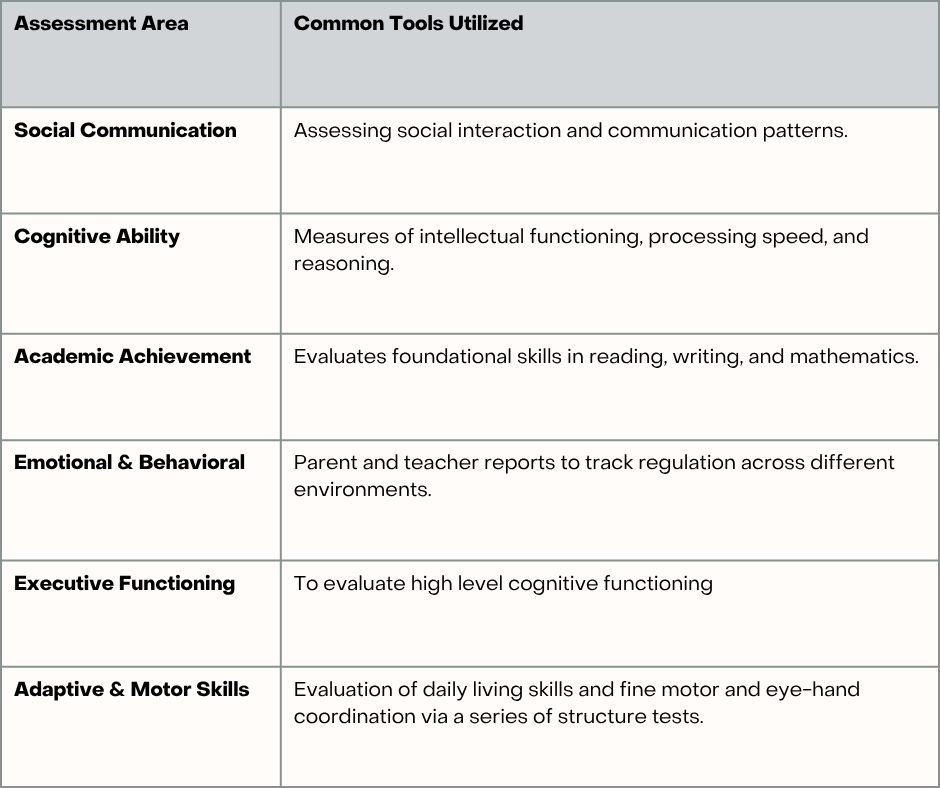
The Assessment Toolkit
We use a robust set of tools to evaluate the "internal scaffolding" your child relies on. This includes a deep dive into how they learn (cognition and academics), how they manage tasks (executive functioning), and how they process emotions and daily life. Every child is different, but the process is designed to be supportive and clear. Here is a walkthrough of how we gather the pieces of the puzzle:
A 6-Step Roadmap: What to Expect
We’ve designed our process to be as clear and supportive as possible. Here is how we build a comprehensive picture of your child:
1. Initial Connection
It starts with a brief call with our Intake Coordinator, followed by a short parent survey to help us understand your child’s life at home.
2. Parent Interview (2 Hours)
This parent-only session is a deep dive into your child’s history, your current concerns, and your goals for the evaluation.
3. Discovery & Testing
Your child will meet with a clinical psychologist for one to three sessions (up to 4 hours each). We create an engaging environment where your child can show us how they think, learn, and problem-solve.
4. Collaborative Analysis
Behind the scenes, your clinician builds a 360° view. We score all measures and consult with your child’s "circle of care"—including teachers, therapists, and tutors—to ensure every perspective is captured.
5. Results, Report & Feedback
We sit down to discuss the findings and actionable next steps:
Parent Session (60–90 min): A detailed review of results and recommendations.
Child Session (30–60 min): If appropriate, a 1:1 "brain strengths" talk to empower your child.
The Report: You’ll receive your full written report within two weeks of our meeting.
6. School Advocacy
To ensure the roadmap is put into action, your clinician can participate in a school debriefing to share results directly with your child’s educational or school-based team.
A psychological evaluation is a window into your child’s unique world. Remember: testing doesn't define your child; it empowers them. Our goal is to use these insights to bridge the gap between 'what’s happening' and 'why,' helping to foster a space where your child can shine.
If you have questions about psychological testing, want to know more about learning differences, or are wondering if your child might be in need of more dedicated support, get in touch with us today. Our goal is for you to have a clear understanding of the testing process and of your child’s learning profile, so that you can support and advocate for them as they continue to learn and grow.



Our Psychological Testing & Assessment team (L-R):
Joe Tarantino, Ph.D., Licensed Psychologist, Senior Supervising Clinician, and director of operations.
Haley Peele, Ph.D., Licensed Psychologist
Shari Aronson, Ph.D., Licensed Psychologist
